From Document Chaos to Strategic Assets: Unlock True Document Value with the DVM Model
In today's data-driven world, most organizations are unknowingly harboring a significant liability: a chaotic ecosystem of unmanaged, undervalued, and high-risk documents. This digital clutter isn't just an administrative headache; it's a drain on resources, a barrier to efficiency, and a source of unquantified business risk. The Document Value Management (DVM) Model is the definitive solution to this challenge. It is a proprietary, strategic framework born from over 40 years of combined, real-world experience in the document and information management domain by its creators, Marco Janssen and Martijn Buurman. This is not academic theory. It is a battle-tested methodology for achieving total clarity, control, and tangible value from your most critical information assets.
The Strategic Blind Spot: The True Cost of Unmanaged Documents
For many enterprises, "document management" is a misnomer; it is, in practice, merely "document storage." Information is saved in disparate systems, with inconsistent naming conventions and no clear sense of ownership or value. This common practice creates a strategic blind spot, leading to significant and often unmeasured business risks that directly impact the bottom line. The failure to properly manage information is not an administrative issue—it is a critical failure in enterprise risk management.
The consequences of this neglect manifest in tangible ways, threatening the core pillars of your organization. The very aspects used to measure document value (for example Reputation, Continuity, Financial Impact, and Legal Compliance) are the same pillars that define enterprise stability. By allowing documents related to these areas to remain unmanaged, an organization implicitly accepts a dangerous level of unquantified risk. This strategic blind spot leads to specific and costly pain points:
In an age of constant scrutiny, the inability to produce a critical document or the accidental leak of sensitive information can cause irreparable harm to an organization's brand and stakeholder trust.
When critical operational documents are incorrect, outdated, or simply cannot be found, business continuity is threatened. Processes grind to a halt, decisions are delayed, and valuable employee time is wasted on searching for information instead of acting on it.
The monetary impact is often severe. It can range from fines for missed contractual obligations and penalties for non-compliance to poor strategic decisions made based on faulty or incomplete data.
Navigating the complex web of regulations like GDPR, industry-specific standards, and legal discovery is impossible without structured document governance. The failure to produce required documents during litigation or an audit can have catastrophic legal and financial consequences.
Your organization's most valuable asset is typically its collective knowledge. When technical designs, strategic plans, and research reports are buried in digital landfills, you lose your institutional memory and risk the leakage of vital intellectual property.
The Document Value Management (DVM) Model: Your Blueprint for Clarity and Control
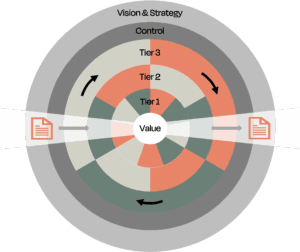
The Document Value Management (DVM) model provides a holistic, structured solution to the chaos of unmanaged information, offering a clear, methodical journey that contrasts sharply with the ad-hoc, reactive approaches that are failing organizations today. The core philosophy of the DVM model is a fundamental paradigm shift: it compels you to stop asking, "Where do we store this?" and to start asking the far more powerful question: "What is this document's true value, and how must our management of it reflect that value?" The strength of the DVM model lies in its transparent, multi-phase process. Business leaders are rightly wary of vague consulting promises that lack a clear path to results. The DVM model replaces ambiguity with a logical, data-driven progression through distinct phases: Analysis, Goal Setting, Gap Analysis, and Implementation. This structured approach transforms the overwhelming problem of information management into a manageable, measurable project, providing a defensible strategy for investment and change. It is a journey from the unknown to a concrete, actionable plan that delivers predictable outcomes.
The Three Pillars of Document Intelligence
The DVM model is built on three pillars that work in concert to create a complete and actionable picture of your document ecosystem. Each pillar provides a unique layer of intelligence, moving from foundational organization to quantifiable value and, finally, to an objective measure of process quality.
Foundational Order Strategic Document Categorization
First, foundational order is established through Strategic Document Categorization. Before value can be assessed, the DVM model tames chaos by systematically classifying every document into a specific Category and Type based on its function and lifecycle. This creates a logical and universally understood information architecture across the entire organization.
Uncovering True Worth Document Value Matrix & Tier System
Second, the model uncovers true worth using the Document Value Matrix and a Tier System. Once order is established, the DVM model assigns quantifiable business value to each category using the Document Value Matrix. This tool assesses each category against ten distinct dimensions of business value which are weighted collaboratively to be classified into one of three distinct tiers.
Measuring What Matters Capability Maturity Model (CMM)
Third, the model measures what matters with the Capability Maturity Model (CMM). To complete the diagnostic, the DVM model provides an objective assessment of your current processes. It utilizes the industry-standard CMM to score the management of each document category on a scale from 1 to 5, replacing subjective opinion with a data-driven benchmark for discussing performance.
Your Transformation Journey: From Insight to Impact
The three pillars of the DVM model provide the raw data. The transformation journey is how that data is synthesized into a bespoke, actionable strategy for your organization. This is a collaborative, three step process designed to move you from your current reality to your desired future state with precision and purpose.
Charting Your Reality The "IST" Analysis
The first step in the journey is to create a powerful, single-glance diagnostic tool: the IST ("as-is") Matrix. This matrix visualizes your current state by plotting every document category based on its Value Tier (from Pillar 2) and current CMM Level (from Pillar 3). It instantly reveals critical misalignments between value and effort.
Defining Your Ambition The "SOLL" Vision
With a clear understanding of your current state, the next step is to define your desired future state. This is achieved through collaborative workshops with your organization's leadership to create the SOLL ("to-be") Matrix. This is not a technical exercise conducted in an IT silo; it is a strategic business conversation facilitated by Cartularius experts.
Your Prioritized Roadmap The "IST-SOLL" Delta
The final step of the analysis is the most critical. The "delta" between the IST and SOLL matrices is more than just a gap; it is your personalized blueprint for change and transformation. This delta allows for the generation of a concrete, actionable, and prioritized roadmap for improvement of your document management.
The Cartularius Advantage: A Continuous Cycle of Value
Implementing the Document Value Management model delivers profound and lasting benefits that resonate across the entire organization. It is a framework that provides a continuous cycle of improvement, ensuring that your information management practices evolve alongside your business. The key outcomes include:
Transform your approach to compliance from a reactive, stressful chore to a proactive, predictable, and manageable state.
Eliminate friction in your core processes by reducing the time wasted searching for information and ensuring that the right documents are managed with the appropriate level of rigor.
Safeguard and leverage your most valuable assets—your intellectual property and corporate memory—by preventing them from being lost in digital chaos.
For the first time, ensure that your investment in information management is directly and demonstrably supporting your most important business objectives.
The DVM model is not a one-time fix. It is a living system. The framework allows your organization to periodically re-evaluate its IST/SOLL state as business priorities shift, acquisitions occur, or new regulations emerge. This creates a sustainable capability for managing information as the strategic asset it truly is, positioning Cartularius not just as a vendor, but as a long-term partner in your continued success.
Request a DVM Model Briefing
Ready to transform your documents from a liability into a strategic asset? Stop guessing at the value and risk hidden within your documents. The DVM model provides a data-driven blueprint for control, efficiency, and competitive advantage. Schedule a briefing with our experts to learn how this powerful framework can be applied to your organization.
Discover the power of Cartularius in a personalized demo. Our experts will showcase live examples tailored to your business. Get your questions answered and see how our solution streamlines collaboration and accelerates processes. Schedule your demo today and unlock smarter document management.
Please provide us with your Name, Job Title and Email Address and you will receive the complete predefined list of Document Categories and Document Types in your inbox.
Get Quote (Enterprises)
Please provide us with as much relevant detail on your needs as possible at this stage in the form below. We understand your business is unique and we would very much like to get you the best offer possible. Thank you!
Get Quote (Non-Profit)
Please provide us with as much relevant detail on your needs as possible at this stage in the form below. We understand your business is unique and we would very much like to get you the best offer possible. Thank you!
Beheer toestemming
Om de beste ervaringen te bieden, gebruiken wij technologieën zoals cookies om informatie over je apparaat op te slaan en/of te raadplegen. Door in te stemmen met deze technologieën kunnen wij gegevens zoals surfgedrag of unieke ID's op deze site verwerken. Als je geen toestemming geeft of uw toestemming intrekt, kan dit een nadelige invloed hebben op bepaalde functies en mogelijkheden.
Functioneel
Always active
De technische opslag of toegang is strikt noodzakelijk voor het legitieme doel het gebruik mogelijk te maken van een specifieke dienst waarom de abonnee of gebruiker uitdrukkelijk heeft gevraagd, of met als enig doel de uitvoering van de transmissie van een communicatie over een elektronisch communicatienetwerk.
Voorkeuren
De technische opslag of toegang is noodzakelijk voor het legitieme doel voorkeuren op te slaan die niet door de abonnee of gebruiker zijn aangevraagd.
Statistieken
De technische opslag of toegang die uitsluitend voor statistische doeleinden wordt gebruikt.De technische opslag of toegang die uitsluitend wordt gebruikt voor anonieme statistische doeleinden. Zonder dagvaarding, vrijwillige naleving door je Internet Service Provider, of aanvullende gegevens van een derde partij, kan informatie die alleen voor dit doel wordt opgeslagen of opgehaald gewoonlijk niet worden gebruikt om je te identificeren.
Marketing
De technische opslag of toegang is nodig om gebruikersprofielen op te stellen voor het verzenden van reclame, of om de gebruiker op een site of over verschillende sites te volgen voor soortgelijke marketingdoeleinden.
Om de beste ervaringen te bieden, gebruiken wij technologieën zoals cookies om informatie over je apparaat op te slaan en/of te raadplegen. Door in te stemmen met deze technologieën kunnen wij gegevens zoals surfgedrag of unieke ID's op deze site verwerken. Als je geen toestemming geeft of uw toestemming intrekt, kan dit een nadelige invloed hebben op bepaalde functies en mogelijkheden.
Functioneel
Always active
De technische opslag of toegang is strikt noodzakelijk voor het legitieme doel het gebruik mogelijk te maken van een specifieke dienst waarom de abonnee of gebruiker uitdrukkelijk heeft gevraagd, of met als enig doel de uitvoering van de transmissie van een communicatie over een elektronisch communicatienetwerk.
Voorkeuren
De technische opslag of toegang is noodzakelijk voor het legitieme doel voorkeuren op te slaan die niet door de abonnee of gebruiker zijn aangevraagd.
Statistieken
De technische opslag of toegang die uitsluitend voor statistische doeleinden wordt gebruikt.De technische opslag of toegang die uitsluitend wordt gebruikt voor anonieme statistische doeleinden. Zonder dagvaarding, vrijwillige naleving door je Internet Service Provider, of aanvullende gegevens van een derde partij, kan informatie die alleen voor dit doel wordt opgeslagen of opgehaald gewoonlijk niet worden gebruikt om je te identificeren.
Marketing
De technische opslag of toegang is nodig om gebruikersprofielen op te stellen voor het verzenden van reclame, of om de gebruiker op een site of over verschillende sites te volgen voor soortgelijke marketingdoeleinden.