
In today’s information-driven economy, documents are the lifeblood of business. Yet many organizations still treat document management as a bureaucratic necessity – a cost center or compliance checkbox – rather than a strategic priority. The result is often a digital “landfill” of files, where critical information is buried and hard to retrieve. Studies show that employees waste enormous time navigating disorganized documents – an average worker spends about 2 hours per day searching for documents, roughly 25% of the workweek lost on low-value tasks. This inefficiency isn’t just frustrating; it directly drains productivity and profits. Clearly, a new approach is needed: one that views documents not as clutter, but as assets to be leveraged strategically.
Treating document management as an afterthought comes at a steep price. Without a strategic plan, companies suffer hidden operational costs and heightened risks. Consider the financial waste: Gartner estimates that implementing proper document management can cut document-related costs by up to 40%, meaning many businesses are overspending nearly half their document budgets due to poor governance. All that lost time searching and recreating files translates into real money. In fact, one analysis found that a typical office spends about $120 in labor just to find a single misfiled document. Moreover, recreating a lost document costs an average of $250 in labor—every single time this happens. These are preventable expenses that eat into the bottom line when documents aren’t managed strategically.
The costs aren’t only internal – regulatory and legal repercussions loom large if document governance is neglected. Compliance lapses (e.g. missing records or unauthorized access to confidential files) can result in staggering fines and business disruptions. One industry study by the Ponemon Institute showed that the average cost of non-compliance is nearly 3× higher than the cost of maintaining proper compliance programs. In other words, trying to save money by doing the bare minimum with documents is a false economy – it often leads to far greater penalties down the road. High-profile cases abound. For example, in 2023 U.S. regulators fined over a dozen major financial firms a combined $549 million for failing to maintain proper recordkeeping of business communications. The message to executives is clear: neglecting document management doesn’t eliminate liability—it amplifies it. A reactive, “store-and-forget” mindset turns documents into ticking time bombs of cost and risk.
Forward-thinking organizations are flipping the script on documents – viewing them as strategic assets rather than liabilities. When managed proactively, documents deliver insights and efficiencies that drive the business. Every proposal, contract, policy, or customer file contains knowledge that teams can use to make smarter decisions. If that information is well-governed – organized, accessible, and up-to-date – employees can retrieve what they need in seconds, not hours, and act on it immediately. This translates into faster sales cycles, quicker issue resolution, and more innovation.
In fact, companies with efficient document practices report substantial productivity gains. By one estimate, effective document management saves up to 6,000 work-hours per year in a mid-sized office by eliminating time spent searching for information or reworking files. That’s the equivalent of nearly three full-time employees’ annual output reclaimed for higher-value work. The boost to overall productivity and agility can be game-changing.
The financial returns of strategic document management are equally compelling. Beyond the cost savings from reducing paper files and storage needs, the efficiency gains and risk reductions yield a high ROI. An IDC study found that modernizing document management can generate a 404% return on investment over five years. Far from being a cost sink, a well-executed document strategy often pays for itself many times over. Freed from the chaos of misfiled or duplicated documents, staff can focus on value-generating activities – serving customers, developing products – instead of hunting for information. Top management can redirect resources that were once wasted on inefficient document handling back into business growth.
Equally important, strategic governance of documents helps preserve institutional knowledge and ensure continuity. Critical know-how captured in files remains accessible even as employees come and go, rather than vanishing in email inboxes. It also strengthens trust: stakeholders and regulators feel confident when a company can swiftly produce accurate documentation on demand (proof of compliance, transaction records, audit trails, etc.). Internally, employees experience less frustration and more empowerment when they have the tools to easily find the information they need – indeed, nearly 43% of employees say they would consider leaving a job if they can’t easily access the documents required to do their work. In short, a strategic approach turns document management from a mundane overhead into a source of efficiency, insight, and competitive advantage.
How can companies make this transformative shift in managing documents? Simply buying new software or scanning everything to the cloud won’t automatically solve the problem. What’s needed is a strategic framework that aligns people, process, and technology – and this is exactly what the DVM model provides. Document Value Management (DVM) is a methodology developed by Upper Spire (the company behind Cartularius) to guide organizations step by step from document chaos to clarity. Think of DVM as a blueprint and toolkit for document transformation. It’s a strategic consulting approach (not tied to any single software platform) that starts with governance and process design before recommending technology. Whether your files live in Salesforce, SharePoint, network drives or paper archives, the DVM principles apply universally – focusing on strategy first, technology second.
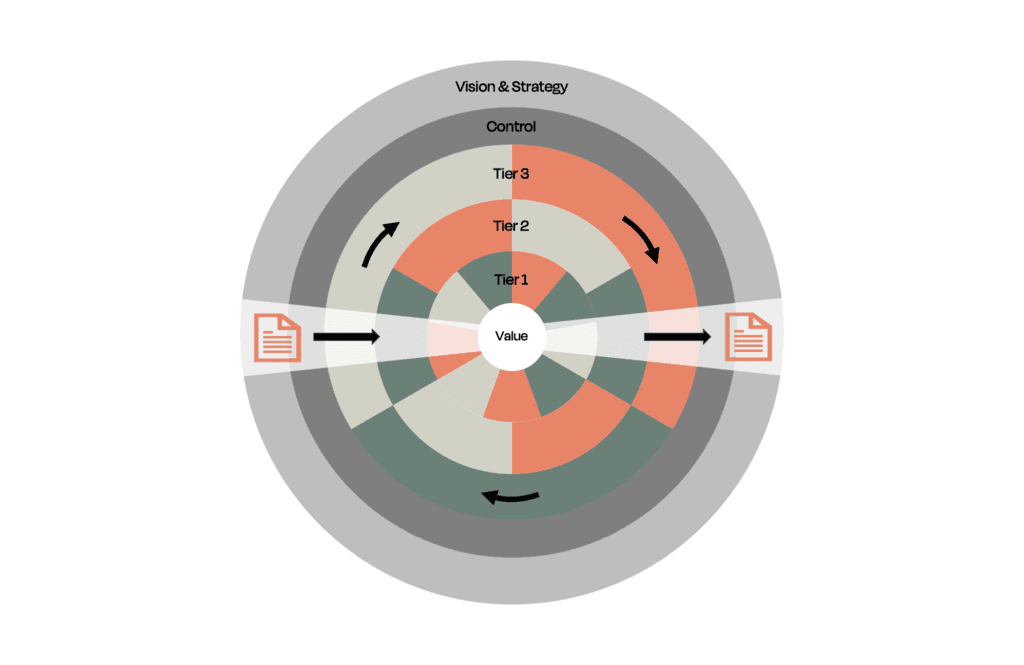
The Document Value Management Model
A proprietary, strategic framework born from over 40 years of combined, real-world experience in the document and information management domain.
Crucially, the DVM model takes a holistic view of document management. It doesn’t treat document challenges as an isolated IT fix, but addresses the triad of people, processes, and technology together. For example, DVM engagements typically implement improvements across all three areas:
By improving document handling across all these dimensions, DVM ensures lasting change rather than a quick band-aid fix. The model is also highly customizable. A small business might use DVM to set up basic governance policies and a simple automated repository that saves staff hours each week. A large enterprise might conduct a thorough audit of its information governance maturity and implement a multi-year roadmap of process improvements and system integrations. In every case, the aim is the same: to shift the organization’s culture and systems so that documents are managed as a source of value, not just a compliance obligation. By partnering with a framework like DVM, C-level leaders can instill the strategic discipline needed to finally get their document house in order – and keep it that way.
Read more about the DVM Model here.
Adopting a strategic document management approach through the DVM model can unlock significant improvements for an organization. The potential gains in efficiency and productivity alone are eye-opening. Research indicates that inefficient document processes can sap over 20% of employee productivity on average. Imagine if your company could reclaim even half of that time. Even a modest 10–20% improvement in document handling efficiency means employees spend less time chasing information and more time serving customers or innovating. Across an entire workforce, that boost translates to thousands of work-hours saved per year – time that directly contributes to revenue-generating activities.
In practical terms, streamlined document workflows might let your sales team process deals faster, your project teams start projects sooner, or your customer service reps resolve inquiries on the first call because they have the right information at their fingertips. Such improvements in cycle times and throughput can ultimately reflect in higher sales and customer satisfaction, giving your company a tangible competitive edge.
Strategic document management also delivers hard cost savings. Fewer inefficiencies mean lower operational costs – less money spent on physical storage, printing, or redundant labor. By one Gartner estimate, many firms could reduce overall document handling costs by about that aforementioned 40% with the right management system and policies. For a mid-size company, that could equate to saving hundreds of thousands of dollars annually. And for enterprises drowning in paperwork, the savings climb into the millions. Importantly, improved document governance significantly reduces the likelihood of costly errors and rework. Preventing the loss of just a handful of important documents (and the subsequent need to recreate them) can save an organization tens of thousands of dollars in labor alone. Over a year, those avoided losses directly bolster the bottom line. Moreover, companies that master their document processes often find that employees can handle higher volumes of work or new business without a linear increase in headcount – effectively doing more with the same resources.
Perhaps the most vital benefit from the C-suite’s perspective is risk mitigation and compliance assurance. A strategic approach like DVM helps institute proper controls – retention schedules, access permissions, audit trails, encryption – that keep the organization on the right side of regulations. This proactive stance can mean the difference between business as usual and a multi-million dollar compliance catastrophe. By preventing compliance issues, an organization avoids not only direct fines (which, as seen, can be enormous) but also the indirect costs of legal battles, remediation efforts, and damaged reputation. It’s hard to quantify the value of a scandal averted or a smooth audit, but executives know that a single compliance failure can set the company back for years. In contrast, a solid document governance program gives regulators and partners confidence that your house is in order – which can even become a selling point. In sectors like finance, healthcare, or manufacturing where documentation is heavily regulated, this can protect revenue streams and open doors to business opportunities that require strict compliance. In short, investing in strategic document management is a form of insurance against operational and legal risks – one that more than pays for itself by avoiding the nightmare scenarios of data breaches, lost records, or regulatory sanctions.
For C-level leaders, the takeaway is clear: it’s time to elevate document management from the backroom to the boardroom. When documents are managed with strategic intent, they stop being a source of drudgery and liability and start becoming a source of value and insight. A disciplined document strategy – like the one enabled by Cartularius’s DVM model – allows your organization to work smarter, faster, and safer. It creates a foundation of organized, accessible information that powers better decision-making and innovation, while simultaneously tightening compliance and reducing costs. The improvements from this approach are not theoretical; they are measurable and significant – from double-digit percentage boosts in productivity to substantial operational savings and risk reduction.
In an era where information is power, no company can afford to leave such an important asset underutilized or mismanaged. By embracing Document Value Management, executives can transform their piles of files into a wellspring of efficiency and opportunity. The companies that have already made this shift are reaping the rewards in agility, compliance peace of mind, and bottom-line results. With a strategic approach to document management, you’re not just tidying up paperwork – you’re fortifying your organization’s future. It’s time to dig into that digital landfill, extract the wisdom buried within, and turn document governance into one of your firm’s greatest strengths. The DVM model offers a proven path to get there, so you can confidently lead your company in leveraging documents as the strategic assets they truly are.
Sources:
Install Cartularius now and experience the best Salesforce document management solution and enjoy clean and structured data and optimized processes, risk-free for 30 days.